Exploring the Future of Nanotechnology: Market Insights Across Emerging Applications

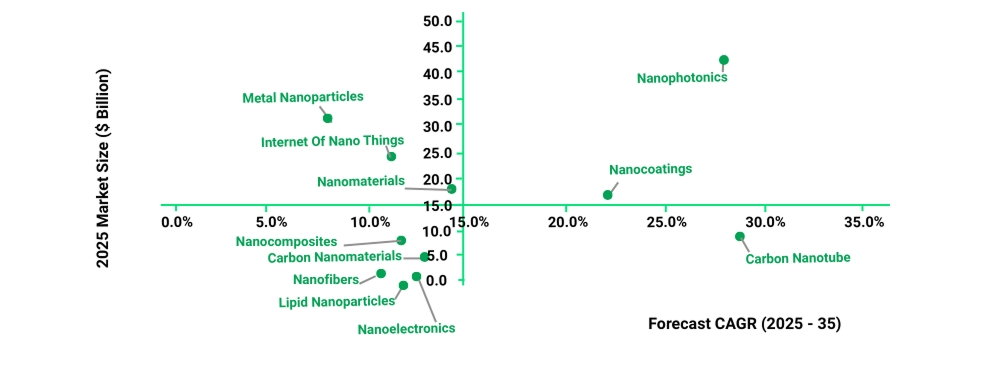
Nanotechnology is unlocking new frontiers in materials science, electronics, healthcare, and industrial coatings. As the ability to engineer materials at the molecular and atomic scale advances, industries are harnessing nanotech for improved strength, efficiency, and performance. This blog analyzes key nanotechnology segments based on their market size in 2025 and expected growth through 2035, highlighting where innovation is concentrated and which applications are scaling fastest.

Exploring the Future of Nanotechnology: Market Insights Across Emerging Applications

Nanotechnology markets vary widely in terms of maturity and momentum. Based on current data, we can group the segments into the following categories:

Nanophotonics icon

Nanophotonics

Nanophotonics, the largest and fastest-growing nanotech segment, is projected to reach $43.7 billion by 2025 with 27.0% CAGR. It plays a key role in next-gen optical devices, photovoltaics, biosensors, and high-speed communication systems. As demand rises for miniaturized photonic components, this segment is poised to drive breakthroughs in telecommunications and energy.

Carbon Nanomaterials icon

Carbon Nanomaterials

With a forecast CAGR of 29.0%, carbon nanomaterials such as graphene and fullerenes are attracting attention in energy storage, electronics, and structural reinforcement. Their high conductivity and strength-to-weight ratio make them ideal for advanced batteries, flexible displays, and smart coatings.

Nanocoatings icon

Nanocoatings

Expected to grow at 22.4%, nanocoatings offer improved durability, corrosion resistance, anti-microbial properties, and thermal insulation. Applications span from automotive to aerospace, and construction to consumer electronics, positioning nanocoatings as a vital layer of performance enhancement.

Nanomaterials icon

Nanomaterials

A $18.9 billion market with 15.6% growth, nanomaterials encompass a wide range of engineered substances used across sectors. From textiles and packaging to electronics and healthcare, these foundational materials are driving better strength, thermal stability, and reactivity in everyday products.

Internet of Nano Things icon

Internet of Nano Things

Combining IoT and nanotech, this $25.7 billion segment enables nano-sensors and actuators to collect and transmit data at ultra-small scales. Use cases include environmental monitoring, biomedical diagnostics, and industrial automation. Growth is supported by advances in 5G, miniaturization, and real-time analytics.

Carbon Nanotubes icon

Carbon Nanotubes

At $5.8 billion with 14.8% growth, carbon nanotubes are key in structural materials, conductive films, and targeted drug delivery. Their unique mechanical and electrical properties make them useful in aerospace, energy storage, and nano-medicine.

Nanocomposites icon

Nanocomposites

Valued at $7.9 billion, nanocomposites enhance polymer, ceramic, or metal matrices with improved mechanical, thermal, and barrier properties. While growth is modest at 11.8%, demand is steady in automotive, defense, and packaging sectors.

Nanofibers icon

Nanofibers

This $2.2 billion segment supports filtration, wound care, and textiles. Though growing at a moderate 10.5%, nanofibers are gaining traction for their high surface-area-to-volume ratio and potential in regenerative medicine.

Nanoelectronics icon

Nanoelectronics

Nanoelectronics enables the miniaturization of circuits for faster, more efficient computing. At $2.0 billion and growing at 14.2%, this segment is critical to ongoing advancements in semiconductors, sensors, and quantum devices.

Lipid Nanoparticles icon

Lipid Nanoparticles

At $1.2 billion and 13.1% CAGR, lipid nanoparticles gained prominence through mRNA vaccine delivery and continue to be explored for targeted drug delivery, gene therapies, and nanocarriers in pharmaceuticals.

Conclusion

Nanotechnology markets are diversifying across core materials, coatings, electronics, and smart systems. While some areas like nanophotonics and carbon nanomaterials are expanding rapidly with strong commercial momentum, others such as metal nanoparticles and nanocomposites provide stable, high-volume applications. As research progresses and use cases multiply, nanotech will increasingly underpin future innovations in energy, medicine, and advanced manufacturing. For innovators and investors alike, the next decade offers a critical window to participate in the evolution of matter itself.

Unlock Industry Insights with The Global Market Model

World's most comprehensive database of integrated market information

Our database provides forecasts for over 16,000 markets, updated semi-annually to reflect the latest
economic, geopolitical, and sector-specific developments. The most recent forecast, updated in January
2026, builds upon the previous insights from July 2025, ensuring unparalleled accuracy and relevance.

Leverage The Global Market Model to stay ahead, ensuring informed decisions in a
rapidly evolving market.