Contact Us

EV 2.0: What Happens When Battery Costs Drop Below 50 Dollars per kWh

Published date : 16th December, 2025

EV 2.0: What Happens When Battery Costs Drop Below 50 Dollars per kWh

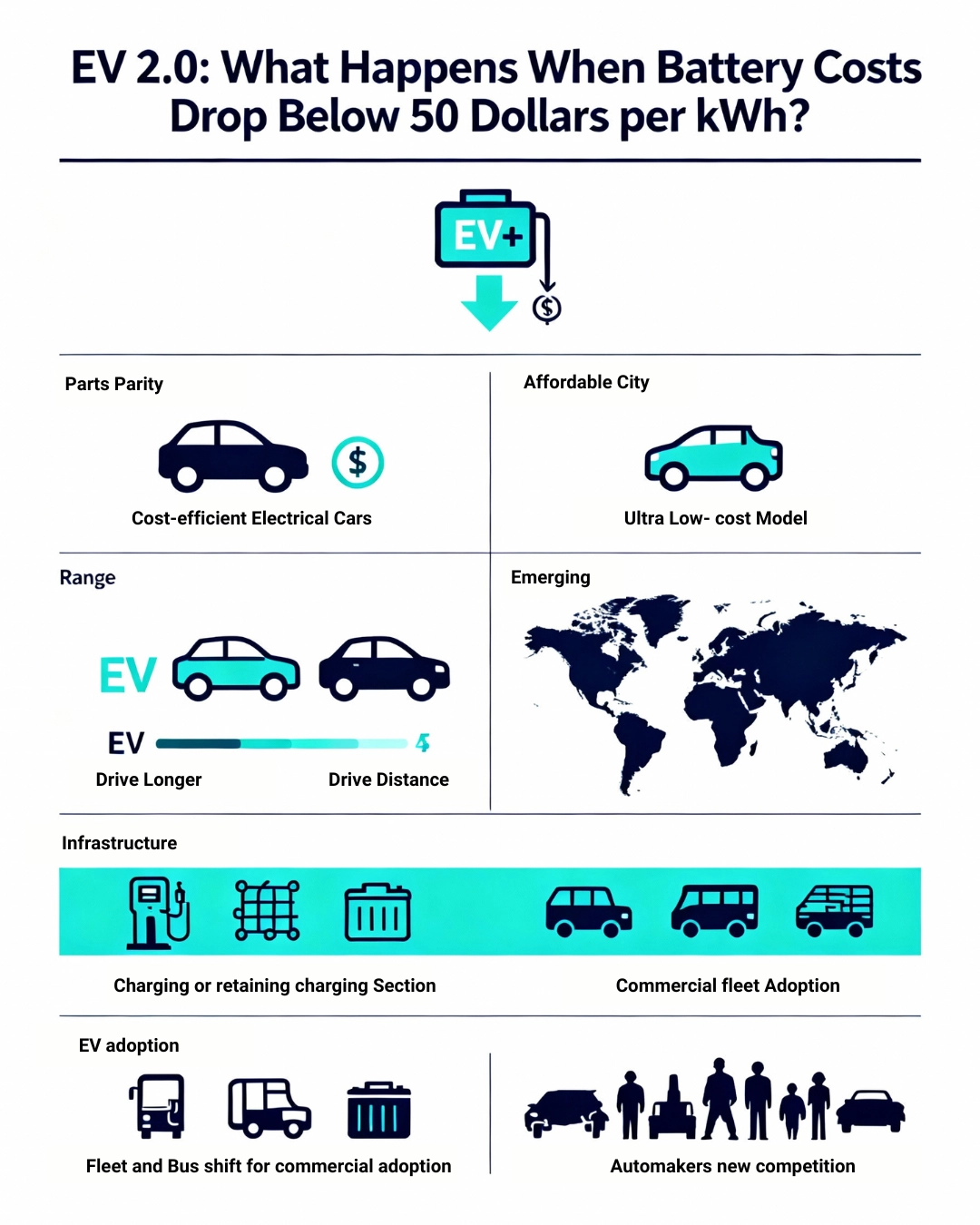
For years, EV battery prices have been the single biggest factor shaping the electric vehicle industry. Everything from how far an EV can drive to how much it costs at the dealership has depended on the price of a kilowatt hour. Analysts used to treat 100 dollars per kWh as the magic number that would spark mass adoption. But the conversation has moved on. Forecasts from BloombergNEF, the Rocky Mountain Institute, and several automakers point to a new milestone that could arrive sooner than expected: battery packs falling below 50 dollars per kilowatt hour.

Reaching this level does far more than make EVs cheaper. It changes the economics of transportation, alters global energy planning, and opens the door to markets that have yet to fully embrace electrification. In other words, it marks the entry into what many are calling EV 2.0, a stage where electric vehicles do not just compete with gasoline cars but replace them at scale.

Cheaper batteries flip the cost equation

Cheaper batteries flip the cost equation

Once battery costs fall below 50 dollars per kilowatt hour, the entire manufacturing picture shifts. Research from institutions such as MIT has shown that this is the point where an EV can be built for less than a comparable gasoline car, even without subsidies. Since the battery is the most expensive part of an EV, reducing that cost reshapes the industry almost instantly.

Automakers are already preparing. Tesla, BYD, Stellantis and several others have tied their long-term strategies to cheaper, higher-volume battery production. BYD’s Blade battery, along with CATL’s LFP and sodium-ion lines, are already priced far below earlier lithium-ion designs. As production scales, manufacturers gain the ability to produce profitable EVs for the entry-level market. That is widely viewed as the tipping point for mass transition.

EV 2.0: What Happens When Battery Costs Drop Below 50 Dollars per kWh
The arrival of the 15,000 dollar EV

The arrival of the 15,000 dollar EV

Lower battery costs also make ultra affordable EVs more realistic. A compact city car with a 40 kWh battery could be sold at the same price as a budget gasoline hatchback. China has already shown the world what this could look like. The Wuling Hongguang Mini EV, which costs well under 5,000 dollars, became one of the world’s top-selling EVs despite its short range.

As battery prices fall, similar models could appear across India, Southeast Asia, Africa, Latin America and Eastern Europe. These are regions where price matters even more than range or luxury features. The Global EV Outlook from the IEA identifies these markets as the next major growth frontier for electrification. A lower battery price finally makes the economics work.

More range without higher costs

More range without higher costs

Another consequence of cheaper batteries is that range becomes easier to improve without pushing up the sticker price. A 600 kilometer EV becomes feasible even in mid-priced segments. That is a major confidence boost for drivers who travel long distances, live outside major cities or rely on their vehicles for business.

Automakers are already racing to combine falling battery costs with new chemistries. Solid-state batteries, high silicon anodes and improved LFP cells are at different stages of development at Toyota, Mercedes, Hyundai and Lucid. As these technologies mature, extended range EVs are likely to become the new normal rather than a premium feature.

Charging networks grow alongside adoption

Charging networks grow alongside adoption

Affordable EVs only succeed if the charging ecosystem keeps pace. Fortunately, major regions are investing heavily in infrastructure. The United States is rolling out thousands of federally funded chargers through the NEVI program. Europe continues to build cross-border fast-charging corridors. India is rapidly adding chargers on major highways through both government agencies and private operators.

As EV adoption rises, private investment increases as well. Charging operators, grid companies and energy providers see a larger customer base and are more willing to expand capacity. New models such as vehicle-to-home systems, smart charging and battery swapping also become more attractive when the number of EVs on the road reaches critical mass.

Examples of growing infrastructure momentum include:

  • Tata Power operating over 40,000 charging points in India.
  • Tesla opening its Supercharger network to multiple brands.
  • NIO completing more than 40 million battery swaps in China, proving that alternative charging ecosystems can scale successfully.
Ultra low battery costs reshape the energy sector too

Ultra low battery costs reshape the energy sector too

Cheaper batteries are not just a transportation story. They also have enormous implications for power grids. Utility-scale storage has historically been expensive, but costs are falling quickly. BloombergNEF expects global storage capacity to expand more than sixfold by 2030.

Once batteries fall below 50 dollars per kilowatt hour, storing renewable energy becomes cheaper than building new fossil fuel peaker plants in many markets. This unlocks higher penetration of wind and solar and reduces dependence on diesel generators in developing countries. Electrification spreads deeper into rural areas, commercial buildings and industrial operations.

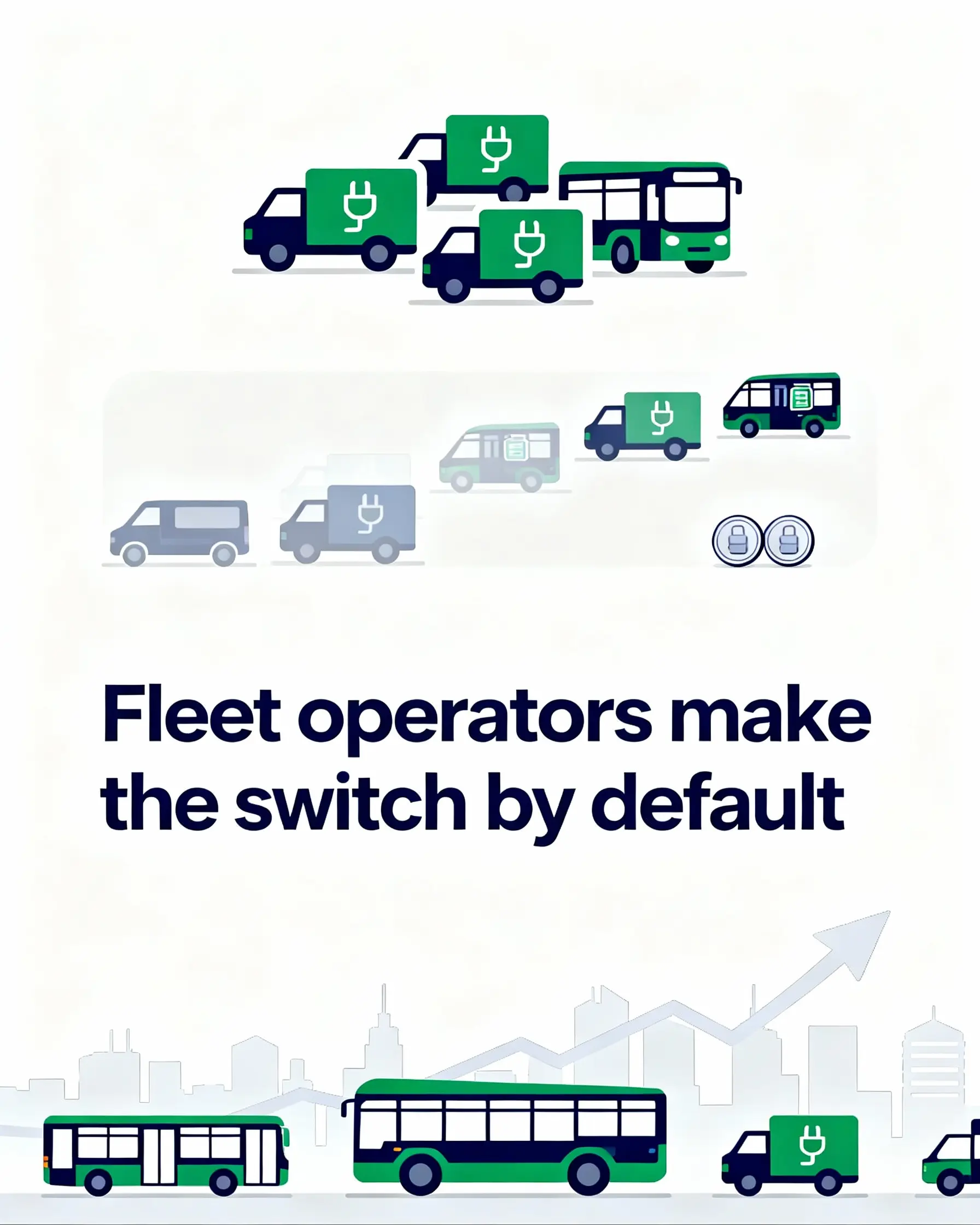
Fleet operators make the switch by default

Fleet operators make the switch by default

Commercial fleets are particularly sensitive to operating costs. Fuel, maintenance and downtime directly affect profitability. As battery costs fall, electric vans, trucks and buses become cheaper to operate than diesel alternatives.

That transition is already underway. Amazon, UPS, DHL and Walmart have introduced thousands of electric delivery vehicles. BloombergNEF predicts that most light commercial fleets will shift to electric options by the early 2030s because the cost savings are too large to ignore.

Cities are also benefitting. Electric buses are quieter, cleaner and more efficient. China now has more than half a million electric buses, a transition made possible by years of falling battery prices.

Automakers enter a new competitive era

Automakers enter a new competitive era

When battery costs drop far enough, automakers begin competing on very different characteristics. Instead of horsepower or luxury features, buyers start comparing software experience, charging convenience and long term reliability. Manufacturers with strong vertical integration such as BYD and Tesla gain an advantage because they control more of the supply chain.

Traditional automakers are adapting rapidly.

  • Ford is investing in LFP battery production with CATL.
  • Volkswagen is building unified cell factories across Europe.
  • Toyota aims to commercialize a solid-state battery EV by 2027.

The companies that adapt fastest will define the next decade of automotive leadership.

Fleet operators make the switch by default
Life after the 50 dollar milestone

Life after the 50 dollar milestone

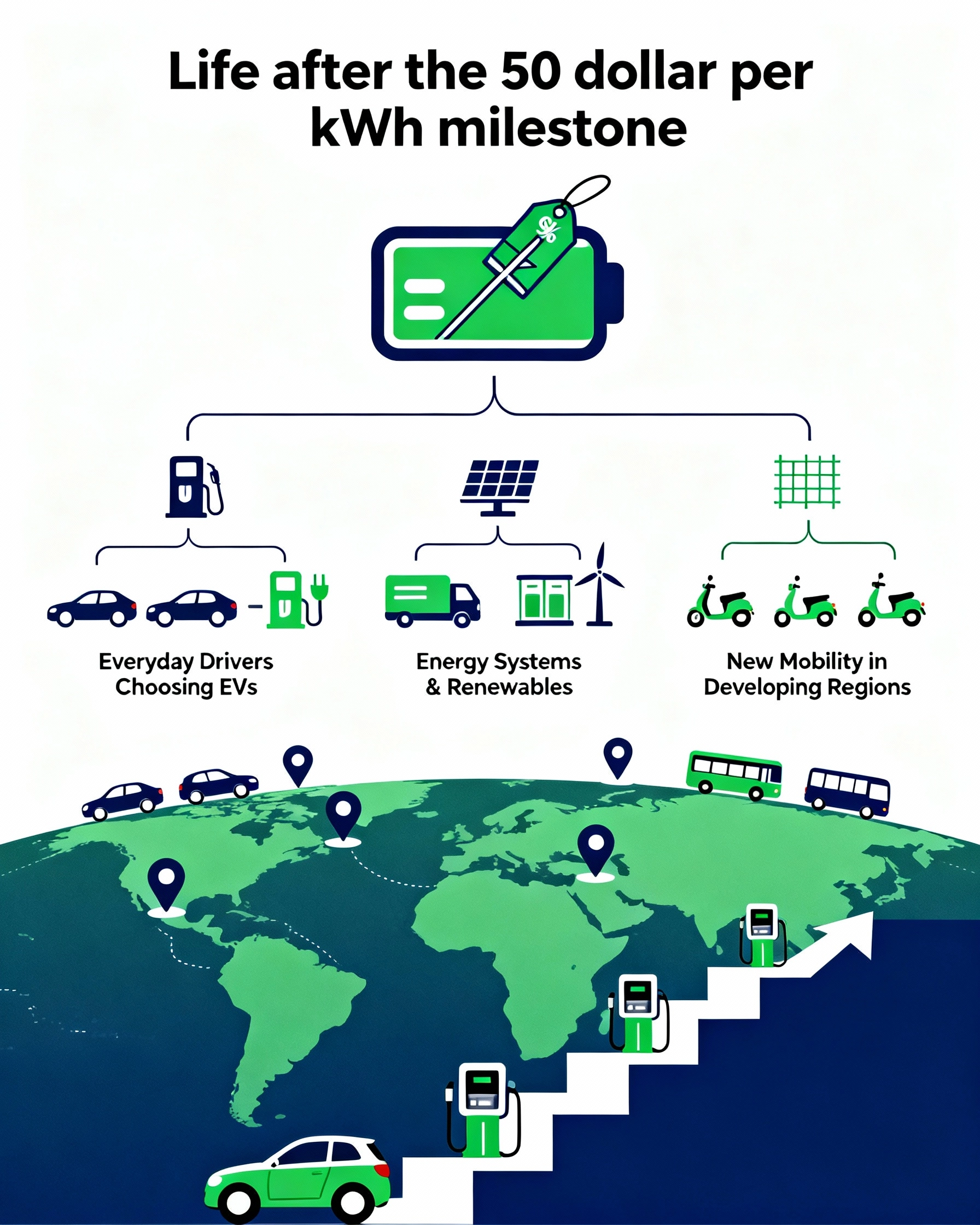
Crossing below $50 per kilowatt hour marks a fundamental turning point for the electric vehicle industry. EV 2.0 is no longer centered on early adopters or markets dependent on subsidies. Instead, it reflects a shift toward mass-market adoption, where everyday drivers choose electric vehicles because they offer a more compelling combination of price, performance, and total cost of ownership than internal combustion alternatives.

This cost inflection changes how vehicles are designed, priced, and marketed. Automakers gain greater flexibility to invest in range, software, safety, and features without pushing up sticker prices. At the same time, EVs become viable across a wider range of vehicle segments, from entry-level models to commercial fleets, accelerating adoption beyond premium categories.

The impact extends well beyond personal transportation. As EVs scale, energy systems begin to evolve alongside them. Cheaper batteries make it easier to integrate renewable power, expand stationary storage, and stabilize grids. In developing markets, lower battery costs open the door to new mobility models, including electric two-wheelers, shared transport, and affordable public transit solutions.

While the pace of change will vary by region, the direction is clear. As battery costs continue to fall, electric vehicles will become cheaper, more capable, and more accessible than anything currently on the road, reshaping not only how people move, but how energy and transportation systems are built for the decades ahead.

Life after the 50 dollar milestone
Back to top WhatsApp icon