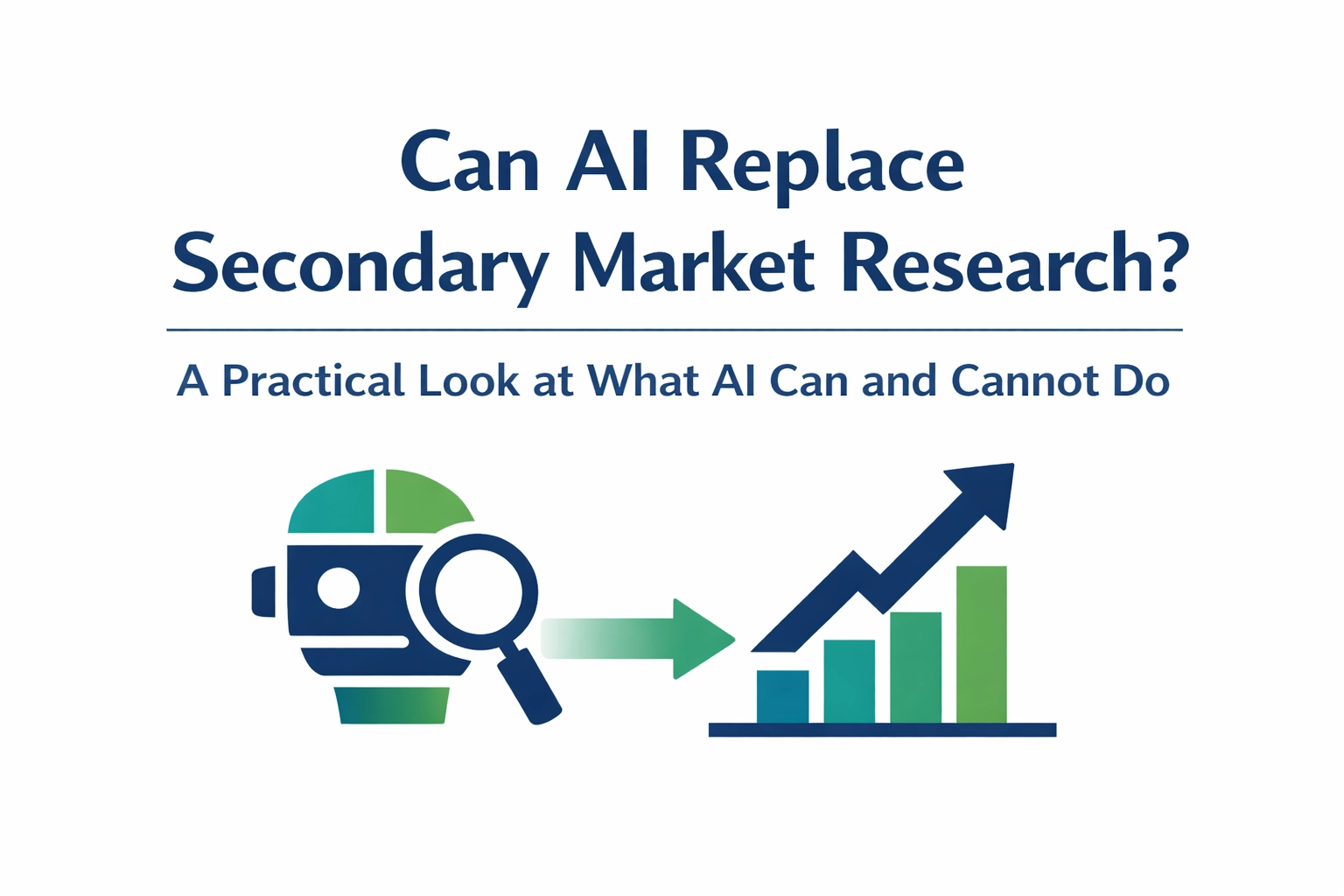
Artificial intelligence is now part of everyday business discussions. Many companies are experimenting with AI tools that promise instant research and quick answers about markets, industries, and competitors. This has led to a common question: if AI can gather so much information so quickly, can it replace secondary market research?
According to Abdul Wasay, COO of The Business Research Company, the question itself is understandable. Businesses are under pressure to move faster and reduce costs, and AI tools appear to offer both.
But he points out that there is an important misunderstanding behind the debate. As he explains, “The confusion I see most often is between information access and decision-making support. AI is genuinely good at the first one.” The challenge begins when businesses expect the second.
Several things have happened at the same time. AI tools have become widely available, and many of them are marketed as platforms that can generate insights instantly. At the same time, organizations are under pressure to make decisions quickly and operate more efficiently.
This combination has created a growing belief that faster answers automatically mean smarter answers.
However, collecting information is only one part of research. Businesses ultimately need guidance on what that information means for their strategy. That step requires context, interpretation, and judgment.
One of the biggest risks businesses face is trusting AI-generated outputs simply because they look credible.
AI tools often produce clean, well-written reports that appear authoritative. The numbers look precise and the explanations sound confident. But that does not always mean the information has been verified.
Abdul Wasay describes this as a dangerous situation. “When an AI tool produces a polished, well-structured output, it looks authoritative. But none of that tells you whether the underlying data is sound.”
If the information behind the report is incomplete or misinterpreted, companies may unknowingly make strategic decisions based on unreliable data.
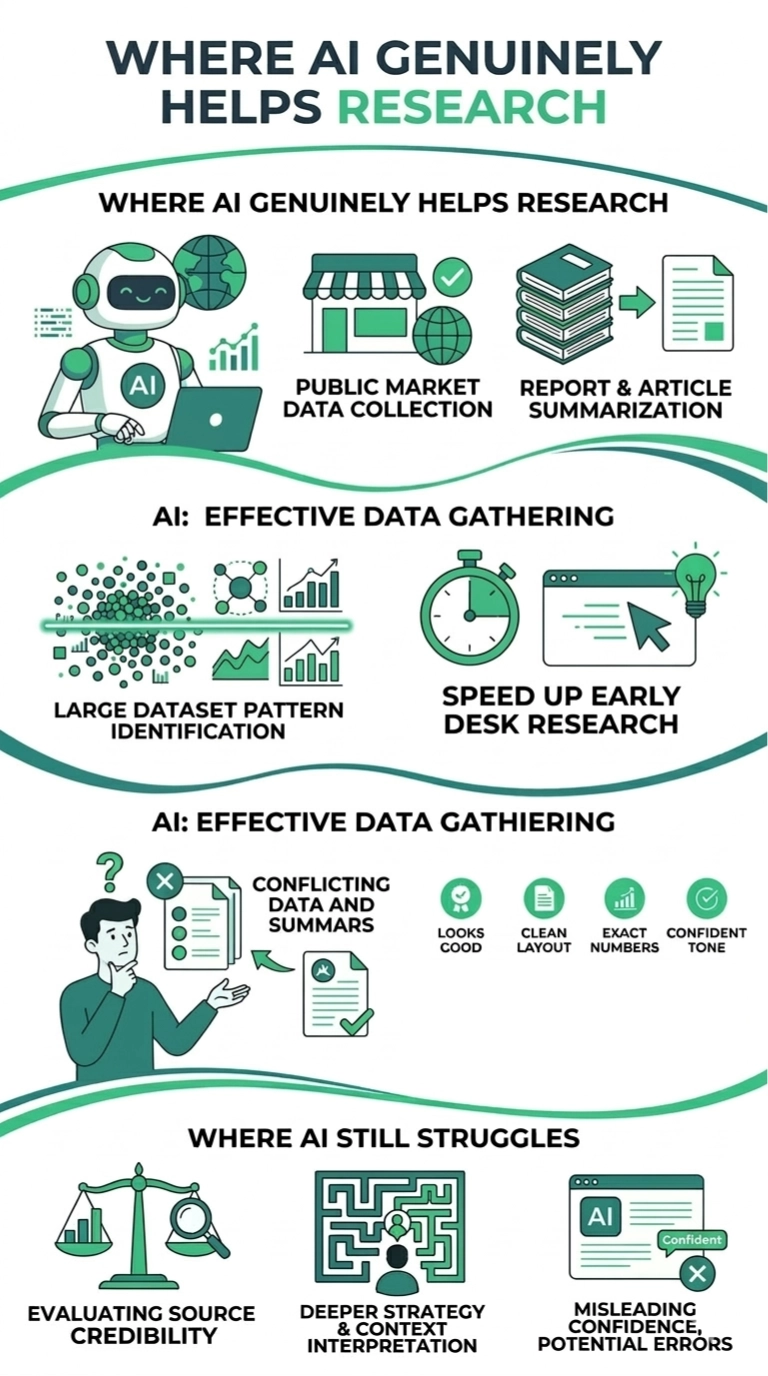
AI does bring real benefits to research teams, especially in the early stages of gathering information.
For example, AI can:
These capabilities can save researchers a great deal of time. Instead of spending hours searching for basic information, analysts can move more quickly to deeper analysis.
In fact, many research teams already use AI in this way. It acts as a helpful tool that speeds up information gathering.
While AI is effective at collecting information, it struggles when deeper judgment is required.
Secondary market research involves more than simply gathering data. Analysts must also evaluate whether sources are credible, relevant, and accurate.
AI does not reliably perform this type of evaluation.
Another issue is that AI often presents information with strong confidence, even when it may be incorrect. As Abdul Wasay puts it, “AI tools produce fluent, authoritative-sounding language regardless of whether the underlying information is accurate.”
Because the output looks polished, it can be difficult for users to recognize when the information may be flawed.
Listen to the full conversation with Abdul Wasay
Good research involves interpretation. Analysts look at multiple sources, compare different viewpoints, and decide which information is most reliable.
Sometimes data points conflict with each other. In those situations, analysts must use experience and industry knowledge to determine which signals matter most.
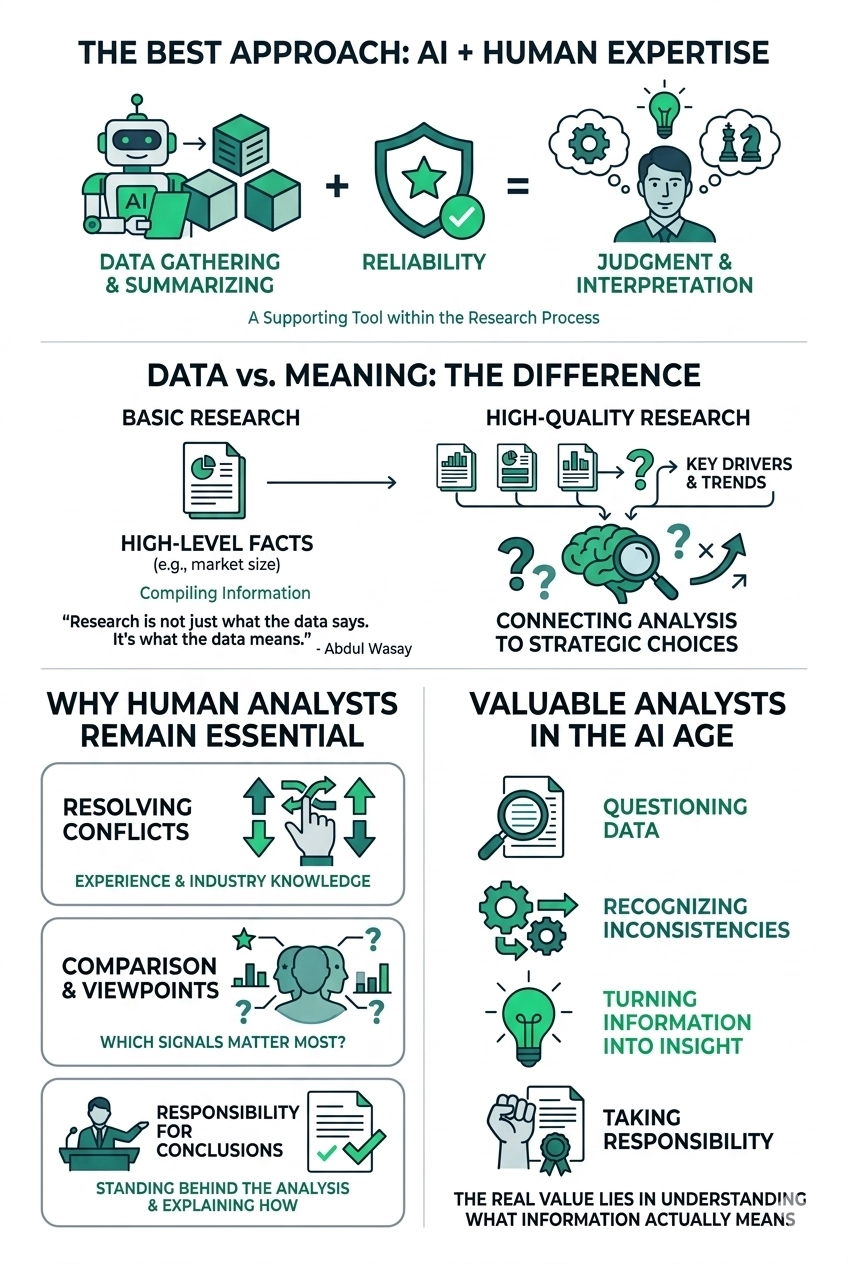
Abdul Wasay highlights this difference clearly: “Research is not just what the data says. It’s what the data means.”
That meaning cannot always be derived automatically from raw information.
Human researchers also take responsibility for their conclusions. When research informs a strategic decision, someone must stand behind the analysis and explain how the conclusions were reached.
Another important distinction is the difference between simply compiling information and turning that information into useful insights.
Basic research reports often provide high-level facts such as market size or growth rates. These details are helpful, but they do not always explain why the market behaves the way it does or what those trends mean for specific business decisions.
High-quality research goes further. It evaluates different sources, explains key drivers, highlights uncertainties, and connects the analysis to real strategic choices.
In many cases, businesses also require customized research that focuses directly on the decision they are trying to make.
Rather than replacing researchers, AI is more likely to become a supporting tool within the research process.
AI can handle tasks that involve large volumes of information, such as gathering and summarizing data. Human analysts can then focus on the parts of research that require judgment, interpretation, and strategic thinking.
This approach allows companies to benefit from both speed and reliability.
As AI-generated content becomes more common, the role of experienced analysts may become even more important.
Skilled researchers know how to question data, identify inconsistencies, and recognize when something does not fit the logic of an industry. They connect different pieces of information and turn them into meaningful insights.
Most importantly, they take responsibility for the conclusions they deliver.
In a world where information is increasingly easy to generate, the real value lies in understanding what that information actually means for a business decision.
Learn more about our custom research services