Contact Us

AI in Drug Discovery: How Close Are We to Real-Time Molecule Design?

Published date : 16th December, 2025

AI in Drug Discovery: How Close Are We to Real-Time Molecule Design?

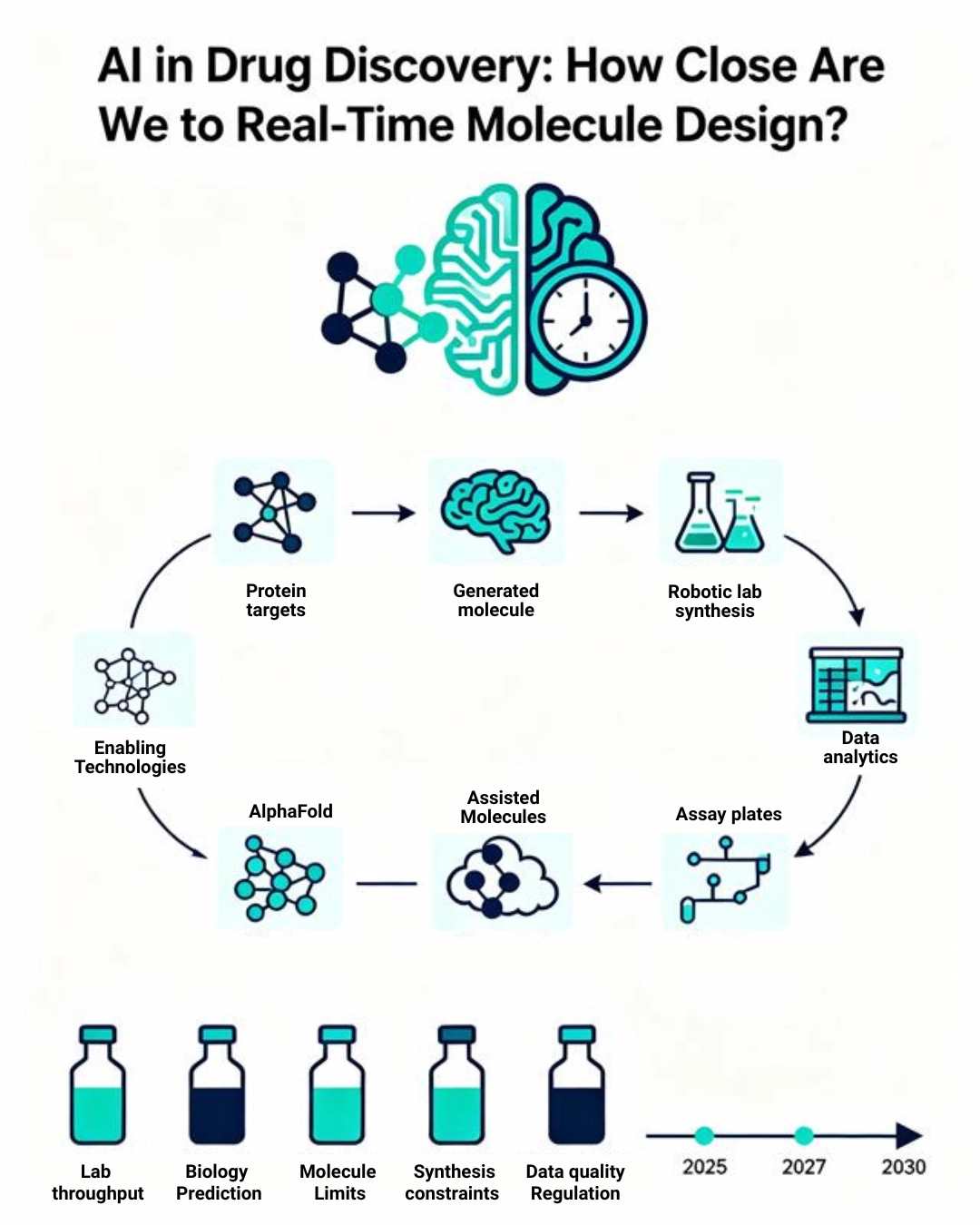
The idea of designing drug molecules in real time has hovered at the edge of science fiction for years. Imagine sketching out a biological target in the morning and having an AI system generate promising molecules, send the best ones to an automated lab for synthesis, and return experimental data before the day ends. That vision is no longer as far-fetched as it once seemed. Some research groups can already run accelerated design cycles overnight, and several pieces of the required workflow are beginning to mature. Still, moving from rapid iteration to a truly dependable, real-time system is a challenge the field has not fully solved.

This article looks at where the science stands today, what real-time design would actually entail, the technologies that make it plausible, and the limitations that still slow progress. The goal is to offer a grounded view of how close or how far the industry is from turning this vision into a daily reality.

What “real time” really means in this context

What “real time” really means in this context

Real-time design does not promise a finished drug ready for clinical trials within hours. Instead, it refers to compressing the early-stage loop from idea to experimentally tested molecule, shrinking cycles that traditionally took months down to days or even hours.

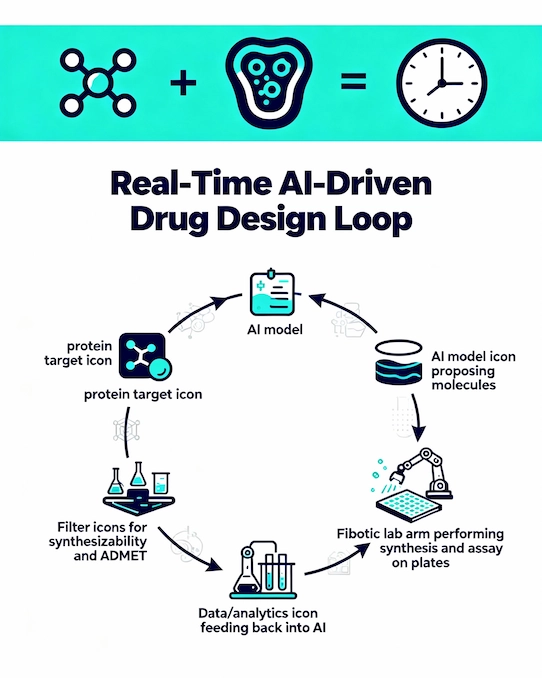
A system capable of real-time design would likely include:

  1. An AI model that proposes molecules tailored to a known protein pocket.
  2. Filters that score synthesizability, ADMET properties, and overall viability.
  3. Automated synthesis and rapid assays performed in a robotic lab.
  4. Algorithms that absorb experimental data and refine the next set of candidates.

Many labs can already perform parts of this chain, and some can connect two or three steps reliably. The difficulty lies in stitching them together end-to-end with the consistency required for drug discovery at scale.

AI in Drug Discovery: How Close Are We to Real-Time Molecule Design?
Advances in modelling that make faster design possible

Advances in modelling that make faster design possible

Two scientific leaps have changed the landscape dramatically. One is the surge in structural biology driven by protein prediction systems such as AlphaFold. By offering highly accurate representations of protein targets, these tools give AI models a clearer picture of where and how molecules interact.

The second leap comes from generative chemistry. Diffusion models and other modern architectures can now produce three-dimensional molecular structures that reflect the physical and chemical constraints of a target. This means AI can propose ideas that are no longer abstract sketches but chemically realistic candidates. In practical terms, tasks that once required weeks of manual design can now be completed in hours of computation.

Turning virtual molecules into something that can actually be made

Turning virtual molecules into something that can actually be made

Proposing a molecule is only part of the challenge. The next step is determining whether it can be synthesised efficiently. AI driven retrosynthesis tools have become much more capable, predicting viable routes and flagging chemistries that are unlikely to work in practice. Even so, many automatically generated compounds remain too complex or expensive to produce.

To address this, the field has begun emphasising synthesis-aware design, where models are trained to avoid generating molecules that are theoretically interesting but impossible to make. For real-time design to succeed, chemistry generation and synthesis planning must work hand in hand rather than functioning as separate stages.

Closing the loop with automation and robotics

Closing the loop with automation and robotics

If AI is the brain of this workflow, self-driving laboratories are the hands. These automated labs handle tasks such as synthesis, purification, and basic biological testing with minimal human intervention. Several collaborations between industry and academia are already demonstrating how these systems can shorten experimental cycles dramatically.

Some labs now run continuous loops where AI recommends molecules overnight, automation synthesises the candidate list, analytics capture assay results, and the next round of design begins almost immediately. While these systems excel in controlled research settings, scaling them reliably for broader drug discovery remains a challenge.

Early wins from companies pushing the frontier

Early wins from companies pushing the frontier

Real progress is happening beyond academic studies. Companies experimenting with AI-driven discovery have already pushed molecules into preclinical and early clinical stages. Startups combining automated wet labs with generative modelling are reporting shorter timelines for certain classes of small molecules. Large pharmaceutical companies are also investing heavily in technologies that integrate modelling, robotics, and high-throughput biology.

These examples do not mean fully autonomous discovery is around the corner. What they do show is that meaningful acceleration is already possible, and companies are willing to invest in maturing the approach.

Closing the loop with automation and robotics
Obstacles that still prevent true real-time design

Obstacles that still prevent true real-time design

Despite the momentum, several bottlenecks remain:

1. Lab throughput

Automated platforms can run experiments quickly, but complex pharmacology still takes time. For many targets, biological validation cannot yet be compressed to hours.

2. Limits of biological prediction

Models can estimate binding affinity or basic properties, but predicting toxicity, immune effects, or off-target risks remains extremely difficult.

3. Synthesis constraints

Not every AI-generated molecule is feasible or affordable to make. Some require rare reagents or multi-step routes that slow down the process.

4. Data quality

Real-time design demands clean, reproducible datasets. Automated labs help, but standardised data workflows are still emerging.

5. Regulatory reality

Even if discovery accelerates dramatically, the path to human trials includes safety studies and documentation that cannot currently be automated.

Obstacles that still prevent true real-time design
So how close are we?

So how close are we?

For well understood targets, design cycles have already shrunk to a matter of days. This means researchers can move through the early exploration phase far more quickly than before. But a system that produces vetted, clinic-ready molecules in truly real-time remains years away.

Expect gradual but meaningful progress in the next two to five years. More labs will adopt diffusion-based molecule generators. Automated R&D facilities will expand. And an increasing number of AI designed molecules will advance to clinical testing. These milestones will build confidence and refine the workflows needed for reliable acceleration.

Practical steps for teams exploring faster workflows

Practical steps for teams exploring faster workflows

Organisations hoping to adopt this approach should start by:

  1. Choosing well characterised targets where predictive models perform best.
  2. Pairing generative tools with strong retrosynthesis systems.
  3. Testing pilot projects with self-driving lab partners before building in house capabilities.
  4. Establishing strict data standards early.
  5. Maintaining documentation that meets regulatory standards from day one.
The bottom line

The bottom line

Real-time molecule design is no longer a wild idea. It is becoming a practical engineering challenge that the field is gradually learning to master. Gains in structural prediction, generative chemistry, synthesis planning, and automation have pushed drug discovery into a new era of speed. Fully autonomous discovery is still ahead of us, but the momentum is undeniable. What happens over the next few years will determine whether closed-loop AI systems become a routine part of how new medicines are created.

Back to top WhatsApp icon